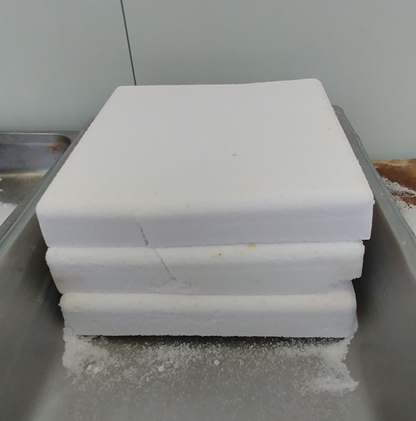
Natural Fertilizer / Plant Growth Promoter
HEH-201 Supreme Natural Fertilizer (Plant Growth Promoter)
HEH-201 Supreme is a natural plant growth promoter and fertilizer designed for agricultural cultivation support. This product page presents field-use visuals and cultivation comparisons across multiple crops, including cucumber, rice, lettuce/radish, and ornamental plants. For technical specifications, dilution guidance, and region-specific application methods, please contact GVT directly.


Key Highlights
- Natural fertilizer / plant growth promoter positioning for agricultural applications.
- Field-use examples across rice, cucumber, lettuce/radish, strawberry, and ornamental crops.
- Suitable for product inquiry pages where technical documentation is shared on request.
- Use according to crop type, local conditions, and approved application practices.
Bioactive Material
5-Aminolevulinic Acid HCl (5-ALA)
GVT supplies 5-ALA HCl (CAS 5451-09-2) out of Korea in agricultural-bulk and reagent-purity grades — backed by 15+ years of hands-on sourcing, documentation, and formulation experience with this exact ingredient, for R&D, formulation development, and agricultural / animal-feed research use.


Two Grades, Matched to Application
Agricultural / Bulk Grade — ≥90%
Minimum 90% 5-ALA (Proton NMR), moisture ≤5%, with dextrin carrier. Matched to biostimulant, fertilizer, and feed-additive formulation work.
Reagent / High-Purity Grade — ≥99%
Minimum 99.0% purity — a real shipped lot tested at 99.5%, moisture ≤1.0%. Matched to R&D, analytical, and precision-formulation use.
How 5-ALA Works
5-ALA is the universal biosynthetic precursor of all tetrapyrroles — the chlorophyll that drives photosynthesis in plants, and the heme that carries oxygen in blood (Beale, 1990, Plant Physiology). Supplying extra 5-ALA helps bypass the natural rate-limiting step in this pathway, which is why exogenous 5-ALA is studied as a growth and vitality input across both plant and animal systems.
Research-Backed Applications
Agriculture & Biostimulants
Low-dose foliar/soil 5-ALA (optimal ≤10 mg/L, growth-regulator range <100 mg/L) increased fresh shoot biomass 4–40% in radish, soybean, and maize, and 8–16% in rice (An et al., 2006, Korean J. Weed Sci.). Reported to enhance photosynthesis, chlorophyll biosynthesis, nutrient uptake, and stress tolerance (Wu et al., 2019, Plant Growth Regulation). Foliar 100 ppm improved lentil height, harvest index, and seed protein under rain-fed and supplemental-irrigation trials (Mohammadi et al., 2023, Scientific Reports).
Animal Feed & Aquaculture
Dietary 5-ALA is linked to growth-performance and immune-marker improvements in broiler chickens, weanling piglets, and dairy cows across peer-reviewed studies, and to hemocyte/immune changes in Penaeus chinensis shrimp (Kim et al., 2006, J. Life Science). GVT’s own documented weaning-piglet trial (DanGook University) recorded Hb +240%, RBC +350%, serum iron +138%, and IgG +223% vs. a no-additive control — full study report available on request.
Formulation & R&D
A documented, quality-checked raw material for formulators: COA and MSDS issued per lot, with FT-IR and ¹H-NMR structural confirmation, ICP heavy-metal screening, and CHN elemental analysis on file. GVT also has multi-year experience blending 5-ALA into chelated micronutrient fertilizer concentrates.
Why GVT for 5-ALA
- 15+ years with this exact molecule — sourcing and trading 5-ALA specifically since 2011, across agriculture, animal feed, aquaculture, and formulation development.
- Documentation, lot by lot — COA, MSDS, FT-IR, ¹H-NMR, ICP, and CHN elemental-analysis certificates issued directly for each shipped lot; independent heavy-metal screen (As, Cd, Cr, Mo, V, Zn, Pb) on file as Not Detected.
- Two purity grades — agricultural-bulk (≥90%) and reagent-grade (≥99%), so buyers can match grade to application and budget rather than take a one-size-fits-all spec.
- Export-ready — established Korea-to-international trade, logistics, and documentation infrastructure via GVT / Nikan Korea’s broader trading operations.
Regulatory Position & Intended Use
- GVT’s 5-ALA is positioned for R&D, formulation development, and industrial / agricultural-input use — it is not marketed as an approved drug, food, or feed additive in any jurisdiction.
- Buyers pursuing a regulated end use (food, feed, drug, or agricultural registration) carry responsibility for their own local registration process; GVT’s lot-level analytical documentation (COA, MSDS, FT-IR/NMR/ICP/CHN data) is available to support that work.
- The global 5-ALA HCl market is estimated by third-party industry research at roughly 8% CAGR (source named on request); methodology is not independently verified by GVT.
Eco-Friendly Solution
New Chito Plus
Eco-friendly solution designed for crop protection and healthier root environments. Below are mechanism visuals and field examples.


Application & Usage (short)
- Designed for agricultural environments where root health and crop resistance matter.
- Use according to field conditions and recommended dilution/application practices.
- Contact GVT for region-specific guidance and technical documentation.
Calcium Raw Materials / Two Grades, Two Uses
GVT Calcium — Coral Calcium & Shell Calcium
GVT supplies two calcium raw materials made by calcining natural marine sources into a fine, water-soluble calcium powder: Coral Calcium, produced from fossilized weathered coral deposits for food and health-functional-food use, and Shell Calcium, produced from recycled oyster shell for agricultural soil and animal-feed use. The two lines are manufactured, tested, and sold separately — each is matched to its own regulatory category and application.
Coral Calcium / Food & Health-Functional-Food Grade
Coral Calcium
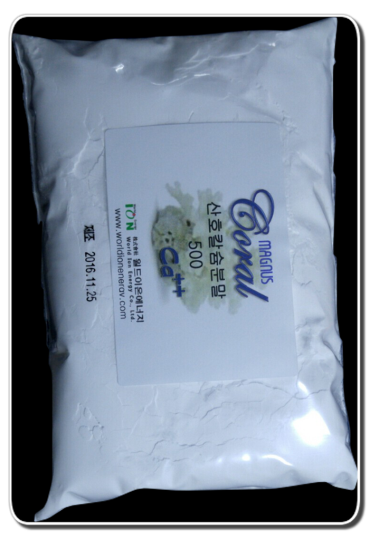
A fine white powder made by calcining fossilized, above-ground weathered coral deposits — not living reef — through a 10-phase burning and 15–30 day natural maturing process that converts calcium carbonate into a water-soluble calcium powder. Supplied as a raw material for food and health-functional-food manufacturers. As a dedicated Coral Calcium supplier, GVT maintains consistent quality from batch to batch.
Quantified Mineral Profile
Independently tested by KAFRI: magnesium, iron, phosphorus, zinc, sodium, potassium, and germanium alongside calcium — a specific, defensible mineral panel rather than an unquantified “trace mineral” claim.
Non-CITES Raw Material
Sourced from fossil, finely-crushed weathered coral fragments — a category recognized as exempt from CITES coral-trade restrictions that apply to live reef or larger identifiable coral pieces.
Tested Purity
Independent lab testing confirms antibacterial activity of the processed powder solution against common bacteria, and no detectable aflatoxin in pistachio decontamination trials.
Regulatory & Commercial Track Record
- Listed under Korea’s Food Code (식품공전) and Health Functional Food Code (건강기능식품공전) as an approved calcium-supplementation raw material.
- Long-standing supply relationship with JW Pharmaceuticals, one of Korea’s major pharmaceutical companies, which has sourced GVT coral calcium as a raw material for its health-supplement lines for years.
- Established export relationship with a buyer in Germany spanning roughly a decade.
- In 2015, GVT exported 5,000 kg of burned coral calcium to Akebono Boeki in Tokyo, Japan.
- Published human research (Ishitani et al., Journal of Nutritional Science and Vitaminology, 1999) found measurably higher calcium-absorption markers from coral-derived calcium than from calcium carbonate at equal doses.
Shell Calcium / Agricultural & Feed Grade
Shell Calcium
A grey powder made by calcining recycled oyster shell — a food-industry by-product that would otherwise be discarded as waste — through a clean, dry, and 7–10 day furnace-burn process, then screened and QC-checked for particle size and pH before packing. Supplied as a soil amendment, liming agent, and animal-feed calcium source.
Built for Agricultural Use
Soil pH Correction
Calcium-carbonate-equivalent of roughly 95–104%, comparable to conventional agricultural limestone — an effective liming agent for acidic soils.
Heavy-Metal Binding
Peer-reviewed research (Ok et al., 2010, Environmental Earth Sciences) found calcined oyster shell immobilizes cadmium and lead in contaminated soils by raising pH and driving precipitation — tested on Korean mine-site soils.
Animal Feed Calcium
A recognized calcium source for poultry layer diets; peer-reviewed testing (Lee et al., Scientific Reports, 2021) found oyster-shell-fed hens developed higher tibia bone mineral density than some alternative calcium sources.
Residue & Pesticide Breakdown
Company testing measured a Captan reduction of 99.96% and a Diazinon reduction of 63.3% in solution — supporting use in soil and water-treatment applications alongside its core liming role.
Circular, Low-Sodium Process
Made from oyster-shell waste that would otherwise require disposal — a recycling stream Korea has supported with dedicated processing infrastructure. Calcining also reduces residual sodium, benefiting soil structure versus raw shell.
International Reach
GVT’s most internationally active line — shipped as an agricultural sample to Germany, field-tested in Nanning, China, evaluated in a university field trial in Cambodia (Battambang Agricultural University / UBB Farm), and under active discussion for an aflatoxin-removal application in Iran’s pistachio industry. GVT is an experienced Shell Calcium fertilizer exporter serving these emerging markets.
Registration & Field Evidence
- Manufactured to Korea’s Fertilizer Process Specification (비료공정규격) framework for agricultural soil-amendment registration.
- University-affiliated lettuce field trial completed at UBB Farm / Battambang Agricultural University, Cambodia.
- Use according to crop and soil type and locally approved application rates; contact GVT for region-specific guidance.